Admin KBS
Author
Introduction
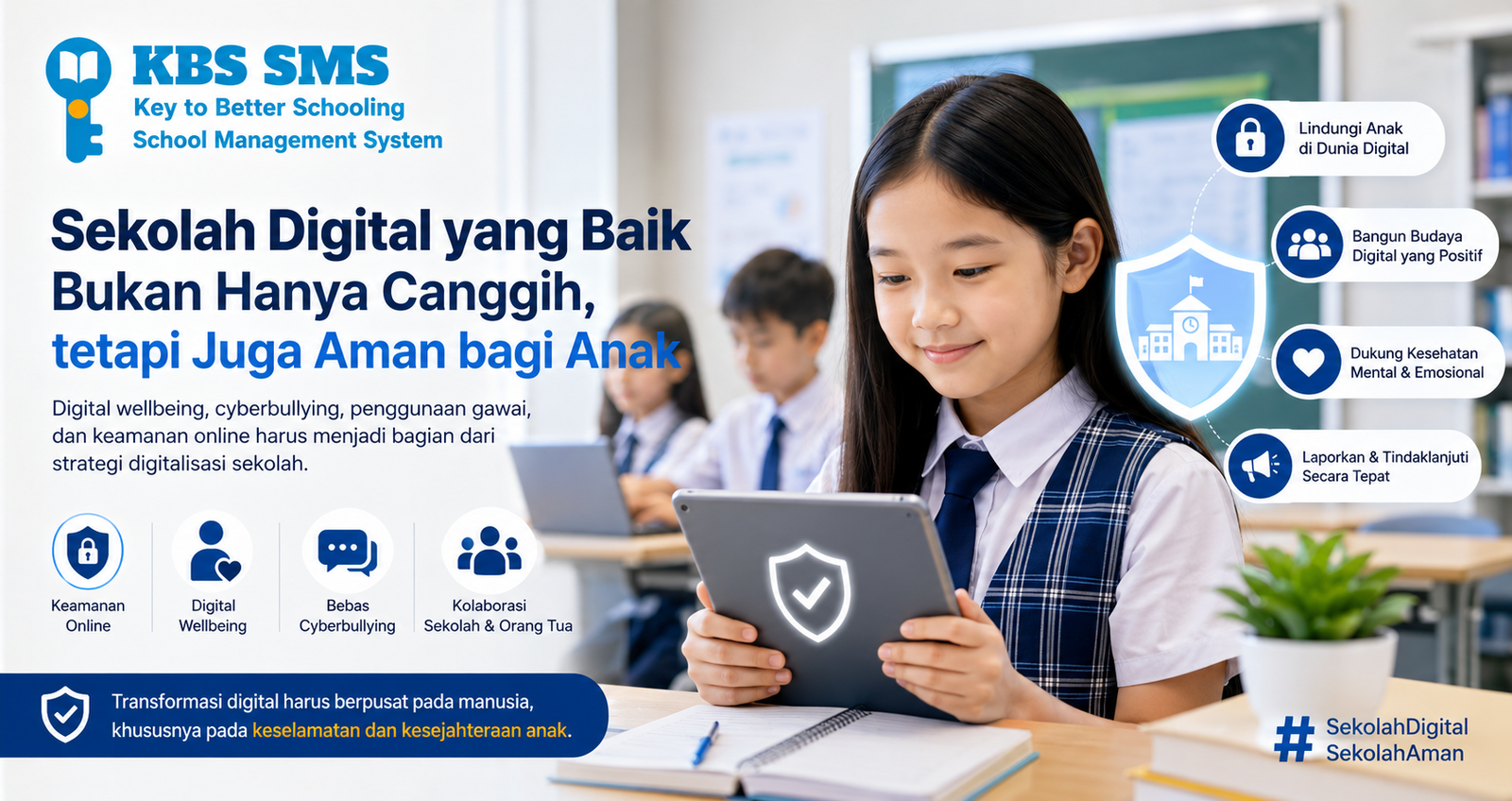
Digital wellbeing, cyberbullying, device use, and online safety should be part of a school's digitalization strategy.
School digitalization is often measured through visible indicators: the number of devices available, the use of learning platforms, computer-based examinations, digital attendance systems, academic dashboards, and school communication that has moved to applications.
All of these are important.
However, as students' lives become increasingly connected to technology, there is an increasingly urgent question:
Does a digital school also make children safer?
This question matters because technology does not only expand learning opportunities. It also expands children's social spaces—from classrooms and school grounds to chat groups, social media, online games, learning platforms, and various digital services that can be accessed almost at any time.
As a result, problems that once ended when students left school can now follow them home.
Bullying can turn into cyberbullying. Social pressure can continue 24 hours a day. Photos and comments can be distributed to hundreds of people within minutes. Children can be exposed to age-inappropriate content, strangers, digital manipulation, exploitation, and patterns of device use that disrupt the balance of their daily lives.
Therefore, digital transformation in education should not be limited to a technology-centered transformation.
It needs to evolve into a human-centered and child-centered digital transformation—technology that not only helps children learn, but also helps protect their safety, wellbeing, privacy, and development.
Children in Indonesia Already Live in a Digital World—but Not All of Them Are Equipped to Stay Safe
UNICEF data demonstrates the scale of this challenge.
According to Online Knowledge and Practice of Children and Parents in Indonesia: Baseline Study 2023, published by UNICEF Indonesia in February 2025, most children in the study used the internet every day, particularly for socializing and entertainment.
However, only 37.5% of children had ever received information about how to keep themselves safe online.
Even more concerning:
- 42% of children had felt uncomfortable or afraid because of an online experience.
- 50.3% of children had seen sexual images on social media.
- More than one-fifth of the children in the study had received sexual images through their social media accounts.
- Some children had received requests to send photos or videos of private body parts.
- 2% of children had experienced threats or blackmail to engage in sexual activities.
These figures do not mean that the internet should be kept away from children.
Instead, they show that digital access is developing faster than some children's readiness to deal with the risks that come with it.
And this is where schools have an important role.
Schools are not only places where children acquire academic knowledge. Within a digital ecosystem, schools can also help children understand how to use technology safely, healthily, and responsibly.
Digitalization Brings Benefits—But Also Expands the Surface of Risk
Technology has provided many benefits to education.
Learning can take place more flexibly. Information is easier to access. Teachers can use multimedia materials. School administration can be integrated. Parents can receive information about their children's development more quickly.
Literature on educational digitalization in Indonesia also shows that technology affects both learning and administrative services.
However, digitalization has both positive and negative sides, meaning that strategies to prevent negative impacts need to be designed alongside technology implementation.
This means that the school's strategic question should not stop at:
“What other technology should we use?”
The next question should be:
“What risks emerge as more and more student activities take place digitally?”
The broader the school's digital ecosystem becomes, the broader the aspects that need to be considered: privacy, communication security, content exposure, online social interaction, device use, cyberbullying, and student psychological wellbeing.
A mature digital transformation therefore requires two agendas to move together:
Digital enablement and digital protection.
Cyberbullying Does Not Stop at the School Gate
Traditional bullying is usually tied to a particular place and time.
Cyberbullying is different.
A degrading message can be sent at night. An embarrassing photo can be shared in a group. Comments can be replicated. Anonymous accounts can be used to attack someone. Content that has already circulated is also much more difficult to control.
Education in the Digital Era: Challenges for Generation Z defines cyberbullying as intimidation, harassment, humiliation, or harmful actions carried out through the internet, social media, messaging applications, or other online platforms.
The literature also explains that anonymity, rapid information distribution, and the disappearance of spatial and temporal boundaries can intensify its impact on victims.
The effects are not always physically visible.
Victims may experience anxiety, emotional distress, reduced self-confidence, and even withdraw from their social environment.
Therefore, cyberbullying should not be viewed merely as a student disciplinary issue.
It is also an issue of student wellbeing, school climate, safeguarding, and digital citizenship.
Digital Wellbeing Is Broader Than Screen Time
When discussing children's safety in the digital era, the conversation often immediately turns to one question:
“How many hours should children be allowed to use their devices?”
Screen time is relevant, but digital wellbeing is much broader than simply counting the number of hours spent in front of a screen.
Digital wellbeing concerns how technology affects a child's overall balance of life: sleep quality, physical activity, concentration, social relationships, emotions, learning, and the ability to control technology use.
Two children may use devices for the same amount of time but have very different experiences.
One child may use a laptop to create a project, discuss something with a teacher, or develop creativity.
Another child may spend the same amount of time doomscrolling, experiencing social pressure, receiving negative comments, or constantly switching between applications until it becomes difficult to concentrate.
Therefore, schools should not only ask:
“How long are students using screens?”
but also:
“What are the screens being used for, in what context, how does this affect children, and is there enough room for non-digital activities?”
This is the shift from simply managing screen time toward healthy technology use.
Digital Schools Need Digital Boundaries
Not every school process needs to become digital simply because technology makes it possible.
Schools need to determine when technology provides added value and when direct interaction is more appropriate.
Project-based learning may require digital devices. However, classroom discussions, sports, arts, games, social activities, physical experiments, reflection, and human interaction continue to have value that should not disappear.
Mature digitalization therefore requires schools to establish digital boundaries.
For example:
- Screen Time — when and how long devices are used for particular purposes.
- Screen Zone — spaces or activities where devices are intentionally used or restricted.
- Screen Break — structured breaks from screen-based activities to redirect attention toward physical, social, and surrounding environmental activities.
The principle is simple:
Technology should be used when it provides educational value, not simply because the technology is available.
Child Online Safety Must Be Part of School Governance
Indonesia is also moving toward a stronger framework for child online protection.
The government issued Government Regulation No. 17 of 2025 concerning the Governance of Electronic System Implementation for Child Protection, which came into effect on March 27, 2025.
The regulation responds to the reality that children use various digital products, services, and features but do not always have the capacity to understand all of the risks involved.
The message is important for education.
Child online safety is no longer solely a matter for parents at home.
Schools, technology providers, government, families, and communities exist within the same child protection ecosystem.
Therefore, school digital strategies need to incorporate safety from the beginning—not wait until an incident occurs.
From Digital Literacy to Digital Citizenship
For many years, schools have focused on digital literacy: how to find information, use devices, access platforms, or evaluate digital sources.
These skills remain important.
However, children also need digital citizenship.
Digital citizenship includes the ability to:
- Respect others when communicating online.
- Understand privacy and digital footprints.
- Protect personal information.
- Recognize manipulation, fraud, and harmful content.
- Recognize when behavior constitutes cyberbullying.
- Know how to report unsafe online experiences.
- Understand the consequences before sharing photos, videos, or comments.
- Use technology in a healthy and responsible manner.
The digital education references underlying this article also place digital ethics as an important element in protecting privacy, building positive online communities, preventing cyberbullying, and reducing the spread of negative information.
Therefore:
Digital literacy teaches children how to use technology.
Digital citizenship teaches children how to live responsibly within a digital society.
Schools need both.
Children Should Know: If Something Happens, Who Can I Talk To?
One of the most important principles of child safeguarding is having a safe reporting channel.
When students experience cyberbullying, receive sexual messages, feel threatened, or witness concerning digital behavior, they should clearly know:
- who they can contact;
- how to report it;
- what will happen after a report is made; and
- whether the report will be handled safely.
UNICEF recommends that victims of cyberbullying preserve evidence, block or report the perpetrator's account, and especially talk to parents, teachers, or trusted adults.
Digital education literature also recommends that schools provide educational programs, counselors or support teams, response mechanisms, and clear rules regarding cyberbullying.
This means that a digital school needs something that is often overlooked when building a system:
A safe reporting channel.
Not surveillance.
Not a system that makes students feel constantly monitored.
Instead, it should be a channel that gives students confidence:
“If something happens to me in the digital world, there is a safe adult I can talk to.”
Wellbeing Check-In: Data Is Not Only About Grades and Attendance
Schools already collect a great deal of data.
Grades.
Attendance.
Assignments.
Examinations.
Late arrivals.
Learning activities.
However, a student's condition is not always reflected in academic numbers.
A student may attend school every day while experiencing social pressure.
Their grades may not have declined yet, but they may be experiencing cyberbullying.
They may continue submitting assignments but feel afraid to open the class group.
Therefore, schools of the future need a broader perspective on student data.
In addition to academic and administrative data, schools need appropriate and proportional mechanisms to recognize student wellbeing signals.
This does not have to take the form of intensive surveillance.
A healthier approach may include simple wellbeing check-ins, access to counseling, support channels, teacher observation, and structured communication with parents.
The purpose is not to diagnose students through algorithms.
The purpose is to help schools recognize more quickly when a child needs human attention.
Parents Must Be Part of the School's Digital Ecosystem
Schools cannot build digital wellbeing alone.
Most of children's digital activities actually take place outside school hours.
Therefore, school digital strategies need to connect three environments:
Student – School – Family.
Parents need information not only about grades and attendance, but also guidance on:
- account security;
- privacy;
- cyberbullying;
- social media use;
- communicating with children about their online experiences;
- balancing device use;
- recognizing signs that a child needs support.
The literature used in this article emphasizes that preventing cyberbullying requires collaboration among individuals, families, educational institutions, digital platforms, and governments.
Therefore, parent engagement is not an additional feature of a child online safety strategy.
It is one of the main layers of protection.
School Technology Should Help Build a Safer Ecosystem
A School Management System is usually perceived as a system for administration, academics, attendance, examinations, or finance.
However, as school systems become increasingly integrated, there is an opportunity to expand their orientation from school operations toward a student support ecosystem.
This does not mean that a School Management System can automatically solve cyberbullying or student wellbeing issues.
Technology cannot replace school counselors, psychologists, homeroom teachers, principals, or parent-child relationships.
However, digital systems can become an enabler that helps schools implement protection and support processes in a more structured way.
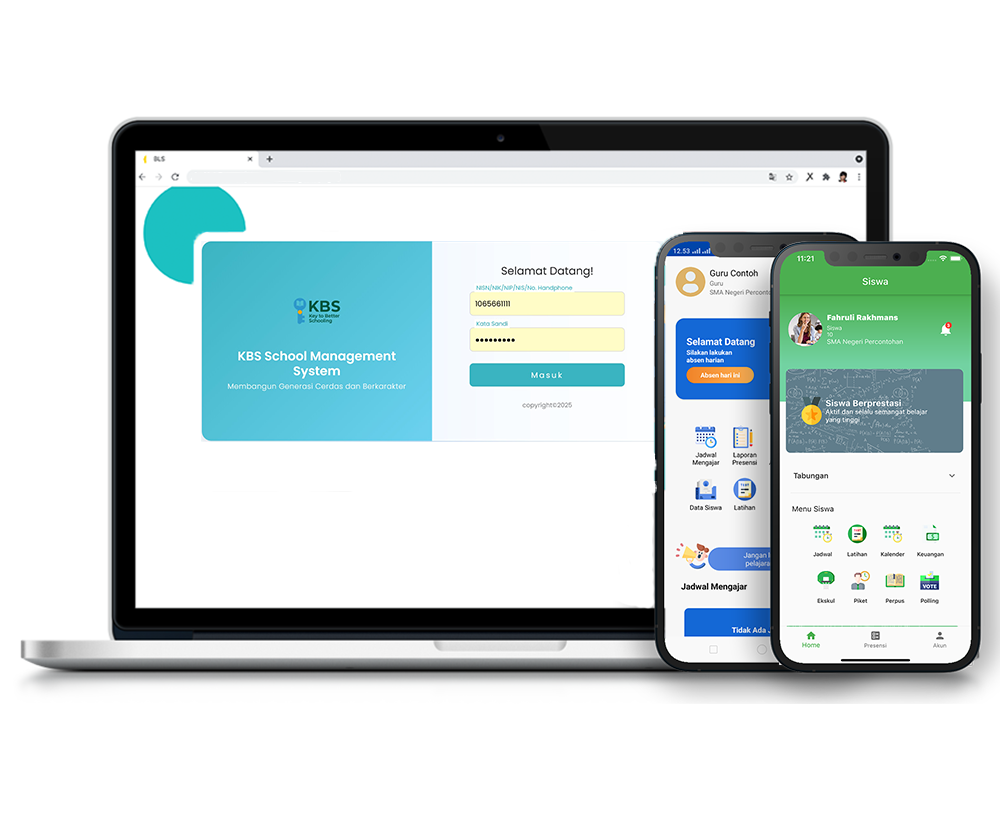
In the context of KBS SMS, system documentation shows that the platform includes Counseling Data, which is intended to help manage student issues beyond the teaching and learning process. The system also includes student data management and communication functions such as Broadcast Messages & History.
Such foundations create opportunities for further development—for example, wellbeing check-ins, safe reporting channels, controlled school-parent communication, digital citizenship resources, and counseling referral mechanisms.
However, it is important to distinguish between capabilities that are already available and potential future developments.
KBS SMS does not automatically make students safer simply because a school uses it.
Its value emerges when the technology is placed within safeguarding policies, school procedures, teacher competencies, counselor support, data protection, and meaningful parent involvement.
[Internal Link: KBS SMS School Management System]
From Smart School to Safe Digital School
Schools are often associated with terms such as:
Smart classroom, paperless school, digital learning, automation, dashboards, AI, and data analytics.
All of these can provide value.
But perhaps there is one much more fundamental indicator:
Do children feel safe within the school's digital ecosystem?
A mature digital school is not a school that moves every activity onto a screen.
It is a school that understands when technology helps, when technology needs to be limited, what risks need to be managed, and how to protect children when those risks actually occur.
Therefore, the journey of school digitalization can be viewed as an evolution:
Connected School
↓
Digital School
↓
Integrated School
↓
Data-Driven School
↓
Safe & Human-Centered Digital School
The final stage is important.
The goal of education is not to create children who spend increasingly more time with technology.
The goal is to help children grow into people who can use technology without losing control over it.
Digital Transformation Must Be Child-Centered
Technology will continue to evolve.
AI will become increasingly integrated into learning. Education platforms will become more personalized. School data will continue to grow. Digital interactions between students, teachers, and parents will become increasingly intensive.
However, the greater the capabilities of technology, the greater the responsibility to ensure that technology works in the best interests of children.
Therefore, the measurement of successful digitalization in education needs to expand.
Not only:
Is the school faster?
Is administration more efficient?
Is learning more digital?
But also:
Are children safer?
Do they know how to protect themselves?
Do they have somewhere to ask for help?
Is technology being used in a healthy way?
Are parents involved?
Are systems designed with the best interests of children in mind?
Because ultimately:
The best digital school is not the school with the most technology.
The best digital school is a school that uses technology intelligently without losing its responsibility to protect the people behind every screen.
And when those people are children, the standard of protection should be higher—not lower.
Key Data & Facts
- Children who had received information about online safety: 37.5%.
(Source: UNICEF Indonesia, Online Knowledge and Practice of Children and Parents in Indonesia: Baseline Study 2023) - Children who had felt afraid or uncomfortable because of an online experience: 42%.
(Source: UNICEF Indonesia) - Children who had seen sexual images on social media: 50.3%.
(Source: UNICEF Indonesia) - Children who had experienced threats or blackmail related to online sexual activities: 2%.
(Source: UNICEF Indonesia) - Bullying/shaming at school: 18% of girls and 24% of boys.
(Source: UNICEF Indonesia) - Child online protection regulation: Government Regulation No. 17 of 2025.
(Source: Government of Indonesia / Ministry of Communication and Digital Affairs Legal Documentation and Information Network) - Relevant KBS SMS capabilities: Counseling Data, student data, and communication/broadcast functions.
(Source: KBS SMS Version 2.0 Manual Book)
Editorial Note: The UNICEF data on online safety comes from a study of children and parents in Indonesia and should be understood as findings from the study population, not as a claim that the percentages automatically represent every student or every school in Indonesia.
References
- UNICEF Indonesia. Online Knowledge and Practice of Children and Parents in Indonesia: Baseline Study 2023. Published February 2025.
- UNICEF Indonesia. Pengetahuan dan Kebiasaan Daring Anak di Indonesia: Sebuah Kajian Dasar 2023.
- UNICEF Indonesia. Apa itu cyberbullying dan bagaimana menghentikannya? Panduan Cyberbullying UNICEF Indonesia.
- Government of the Republic of Indonesia. Government Regulation No. 17 of 2025 concerning the Governance of Electronic System Implementation for Child Protection. Ministry of Communication and Digital Affairs Legal Documentation and Information Network.
- Purba, P. B., et al. (2025). Pendidikan di Era Digital: Tantangan bagi Generasi Z. Yayasan Kita Menulis.
- Maharani, D. & Meynawati, L. (2024). Sisi Terang dan Gelap: Digitalisasi pada Perkembangan Pendidikan Indonesia. Sinar Dunia, Vol. 3 No. 1.
- Team SICS KBS SMS. (2025). KBS SMS Version 2.0 Manual Book. Documentation of Counseling Data, student data management, and school communication capabilities.
Editorial Closing
This article positions KBS SMS as a digital enabler, rather than claiming that the use of the platform automatically prevents cyberbullying or improves student wellbeing.
Children's safety and wellbeing still require a combination of school policies, teacher and counselor competencies, family involvement, digital literacy, data governance, secure technology design, and response mechanisms when incidents occur.
A mature digital school is not merely a school capable of using technology to accelerate learning and administration.
A mature digital school is a school capable of ensuring that technology is used responsibly, humanely, and with the best interests of children in mind.
Content Copyright
This article is official content owned by PT. Kreasi Bali Sasmita Nusantara (KBS SMS).
Copying, distributing, or republishing any part or the entirety of this article without written permission from the copyright owner is prohibited.