Admin KBS
Author

Introduction
The development of digital technology has changed almost every aspect of human life.
The way people communicate has changed.
The way people work has changed.
The way people access information has changed.
And ultimately, the way people learn and assess learning outcomes has also changed.
Amid these changes, one question still often arises in many schools:
• Is digital assessment really necessary?
Some argue that traditional paper-based assessment is still sufficient to measure students’ abilities.
Others see digital assessment as an inseparable part of modern educational transformation.
This debate is understandable.
However, if we look at the direction of global education development, one fact is becoming increasingly clear:
• Schools may choose when to start digitalizing assessment, but they cannot avoid the need for digital assessment in the long term.
The question is no longer whether digital assessment is necessary, but how schools can use it properly to improve the quality of education.
21st-Century Education Presents Different Challenges
21st-century education no longer focuses only on the transfer of knowledge.
Schools today are required to develop far more complex competencies.
These include:
• Critical Thinking;
• Problem Solving;
• Creativity;
• Communication;
• Collaboration;
• Digital Literacy;
• Adaptability;
• Self-Regulated Learning.
These competencies cannot be measured optimally only through conventional evaluation methods that focus on memorization.
Schools need assessment approaches that are more flexible, adaptive, and capable of generating data that supports students’ continuous development.
This is where digital assessment begins to play an increasingly important role.
What Is Digital Assessment?
Digital assessment is often understood narrowly as online examinations.
In fact, its scope is much broader.
Digital assessment is the use of technology to support the entire assessment process, from:
• instrument development;
• question bank management;
• examination implementation;
• scoring;
• learning outcome analysis;
• reporting;
• academic decision-making.
In other words, digital assessment is not merely replacing paper with a computer screen.
Digital assessment is a transformation in how schools manage and use learning outcome information.
Why Is It Difficult for Schools to Avoid Digital Assessment?
The Increasing Complexity of Educational Data
Every year, schools generate thousands of academic data points.
These include:
• daily scores;
• assignments;
• examinations;
• projects;
• portfolios;
• attendance;
• competency achievements.
Managing all this data manually is becoming increasingly difficult to do effectively.
Digital assessment helps schools organize and use data more systematically.
The Demand for Data-Based Decision-Making
Today, principals and teachers are required to make faster and more accurate decisions.
For example:
• which students need remedial support;
• which competencies have not been achieved;
• which subjects require intervention;
• which teaching methods are most effective.
These decisions require accurate and easily accessible data.
Digital assessment provides the foundation for this need.
Increasing Parental Expectations
Parents today do not only want to know their child’s final score.
They want to understand:
• competency development;
• their child’s strengths and weaknesses;
• learning progress over time.
These expectations are increasingly difficult to meet if schools rely only on manual administrative systems.
Digital Transformation Has Become the New Standard
Across various sectors, digitalization has become an operational standard.
Education is not outside this change.
Just as schools have begun using digital academic systems, digital communication, and digital administration, assessment is also moving in the same direction.
Therefore, digital assessment is no longer merely an innovation, but is becoming a basic need in modern education management.
Digital Assessment Is Not the Same as Multiple-Choice Questions
One common misunderstanding is assuming that digital assessment is identical to multiple-choice questions.
In fact, technology can support various forms of assessment, such as:
Essay Assessment
Measuring critical thinking and argumentation skills.
Hybrid Assessment
Combining multiple-choice questions and essays.
Project-Based Assessment
Measuring competency application through projects.
Portfolio Assessment
Documenting students’ development continuously.
Performance Assessment
Assessing skills through practice and demonstration of ability.
Thus, digital assessment can actually expand the assessment method options available to schools.
What Are Advanced Countries Doing?
Various countries with advanced education systems are not abandoning technology in assessment.
Instead, they are developing assessment systems that are increasingly integrated with technology.
Their focus is not merely digitalizing examinations.
Their focus is:
• using data for quality improvement;
• learning personalization;
• monitoring competency development;
• evidence-based decision-making.
This trend can be seen in various educational initiatives promoted by organizations such as UNESCO and OECD.
This shows that digital assessment is part of the direction of global education development.
Digital Assessment and the Future of Data-Driven Schools
The greatest value of digital assessment is not in the examination itself.
The greatest value lies in the data it produces.
Through digital assessment, schools can build:
Academic Dashboard
Real-time monitoring of student achievements.
Learning Analytics
Analysis of learning patterns and competency development.
Early Warning System
Early detection of students who need support.
Evidence-Based Decision Making
Decision-making based on objective data.
This is the main foundation toward a Data-Driven School.
Challenges in Implementing Digital Assessment
Of course, this transformation is not always easy.
Some common challenges include:
Infrastructure
Availability of devices and internet connectivity.
Teachers’ Digital Competence
The need for training and mentoring.
Changes in Work Culture
Adaptation to more technology-based processes.
Data Governance
Security and integrity of academic data.
However, these challenges are better viewed as a transition process rather than a reason to delay transformation.
Recommendations for Schools
Develop a Digital Assessment Roadmap
Implement it gradually and in a planned manner.
Start from the Most Urgent Needs
Focus on areas that provide the greatest benefits for the school.
Improve Teachers’ Competence
Investment in human resources is just as important as investment in technology.
Combine Various Forms of Assessment
Use technology to support multiple-choice questions, essays, projects, and portfolios.
Focus on Data Utilization
Do not stop at digitalizing the process.
Use data to improve the quality of learning.
Towards a Modern School Assessment Ecosystem
In the future, schools need a system that is able to integrate:
• digital question banks;
• multiple-choice examinations;
• essay examinations;
• hybrid assessment;
• project assessment;
• portfolio assessment;
• learning outcome analysis;
• academic dashboards.
In this context, digital assessment is not only an evaluation tool, but part of the foundation of modern educational transformation.
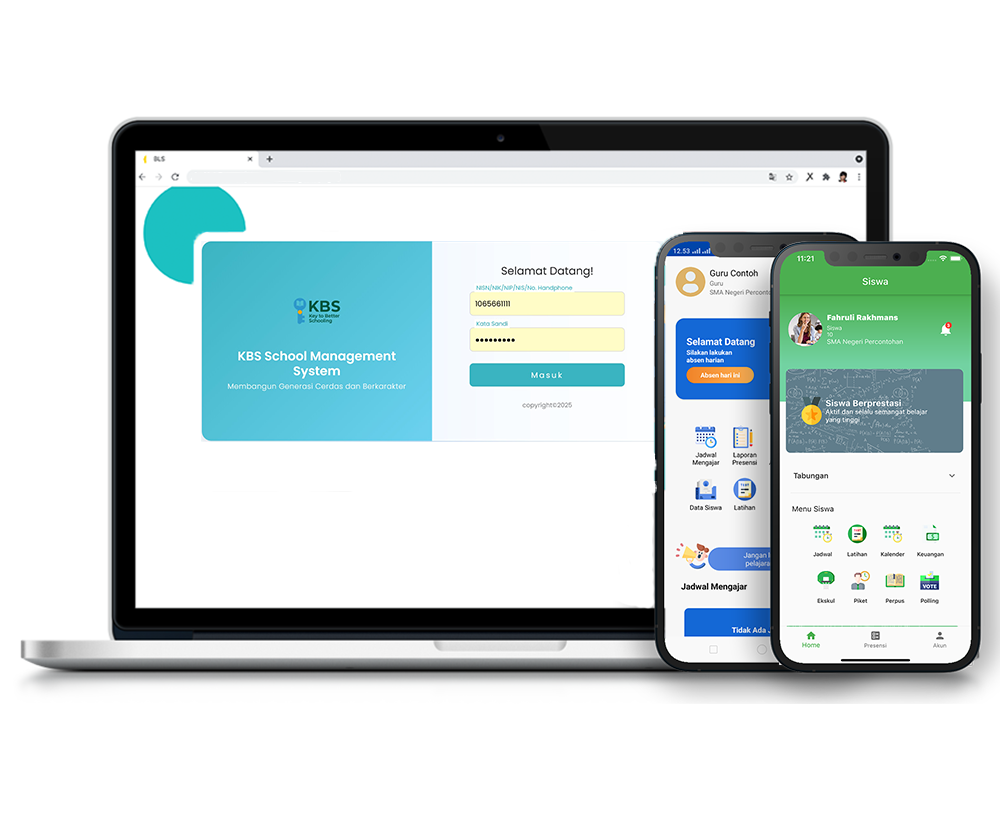
This philosophy is one of the development directions of KBS SMS (Key to Better Schooling – School Management System), namely helping schools manage assessments more effectively, flexibly, and based on data to support the improvement of education quality.
Conclusion
21st-century education presents increasingly complex challenges.
Schools are not only required to teach new competencies, but also to measure those competencies more effectively.
In this context, digital assessment is not merely a technological option.
Digital assessment is a need that arises from the demands of modern education management, the increasing complexity of data, and the need for faster decision-making.
Therefore, the relevant question is no longer:
• "Do schools need to use digital assessment?"
But rather:
• "How can schools use digital assessment to improve the quality of learning and student development?"
Schools that are able to answer this question will be better prepared to face the challenges of future education.
FAQ (Frequently Asked Questions)
What is meant by digital assessment?
Digital assessment is the use of technology to support the entire assessment process, from question development to learning outcome analysis.
Does digital assessment only mean online examinations?
No. Digital assessment includes question bank management, scoring, data analysis, reporting, and data-based decision-making.
Can digital assessment support essay questions?
Yes. Current technology can support essay assessment, hybrid assessment, projects, portfolios, and various other forms of assessment.
Why do schools need to use digital assessment?
Because it helps improve efficiency, objectivity, data analysis, and the quality of academic decision-making.
What is the relationship between digital assessment and data-driven schools?
Digital assessment generates data that can be used to build evidence-based decision-making systems and continuous education quality improvement.
References
-
UNESCO. (2023). Global Education Monitoring Report 2023: Technology in Education – A Tool on Whose Terms?
-
UNESCO. (2021). Reimagining Our Futures Together: A New Social Contract for Education.
-
OECD. (2023). PISA 2022 Results.
-
OECD. (2021). 21st Century Readers: Developing Literacy Skills in a Digital World.
-
Redecker, C., & Johannessen, Ø. (2013). Changing Assessment: Towards a New Assessment Paradigm Using ICT.
-
Selwyn, N. (2016). Education and Technology: Key Issues and Debates.
-
Luckin, R., et al. (2016). Intelligence Unleashed: An Argument for AI in Education.
-
Black, P., & Wiliam, D. (1998). Assessment and Classroom Learning.
-
Brookhart, S. M. (2010). How to Assess Higher-Order Thinking Skills in Your Classroom.
-
Ministry of Education, Culture, Research, and Technology of the Republic of Indonesia. (2022). Learning and Assessment Guide for the Merdeka Curriculum.
Content Copyright
This article is official content owned by PT. Kreasi Bali Sasmita Nusantara as the developer of KBS SMS (Key to Better Schooling – School Management System).
All contents of this article are protected by copyright. It is prohibited to copy, distribute, or republish part or all of this article without written permission from PT. Kreasi Bali Sasmita Nusantara (KBS SMS) as the copyright owner.