KBS Team
Author

2026 marks a pivotal turning point in Indonesia's education transformation. Education policy is increasingly pushing schools to adopt online and hybrid learning as a core part of digital modernization.
But the real question is: are schools actually ready?
Many schools have begun adopting technology, yet they continue to operate on disconnected systems. Attendance, grades, learning activities, and administration each run on separate platforms with no integration. This fragmented setup creates significant risks as online learning policies are rolled out more broadly.
Without the right systems in place, digitalization does not become a solution — it becomes a new source of inefficiency.
The 2026 Online Learning Policy: What Will Change?
The shift to online learning is not just about moving classes to the internet — it represents a comprehensive overhaul of how schools are managed. Schools will be expected to:
- Manage digital-based learning
- Provide learning materials online
- Conduct exams through digital systems
- Manage academic data in an integrated manner
- Improve transparency and communication with parents
This means schools cannot simply "use technology" — they need a school management system capable of handling all of these activities in a structured, cohesive way.
Challenges Facing Schools That Are Not Digitally Ready
Many schools run into serious difficulties when transitioning to digital operations without an integrated system:
1. Disconnected systems
Schools rely on multiple separate applications for attendance, grades, and learning management. The result: data becomes out of sync, tasks get repeated unnecessarily, and oversight becomes difficult.
2. Increased administrative burden on teachers
Teachers are forced to manage several platforms at once. The result: valuable teaching time is lost to administrative tasks, and the quality of instruction suffers.
3. Academic data that is difficult to manage
Data is scattered across multiple systems. The result: analysis becomes difficult and the risk of errors increases significantly.
4. Poor learning monitoring
Schools struggle to track student activity in real time. The result: learning quality declines and problems go undetected.
The Risks of Being Unprepared for the Online Learning Policy
Schools that fail to build the right systems now will face serious consequences when the policy takes effect:
1. Operational inefficiency
Manual processes and disconnected systems slow everything down, creating bottlenecks across the entire school.
2. Inaccurate data
Student information, grades, and attendance records become inconsistent and unreliable.
3. Data errors and duplication
Information gets entered multiple times across different platforms, increasing the likelihood of mistakes.
4. Poor decision-making
When data cannot be trusted, school leaders are unable to make accurate or strategic decisions.
5. Declining learning quality
Without proper monitoring tools, student progress goes untracked and learning outcomes deteriorate.
The Solution: An Integrated School Management System
To meet the demands of the 2026 online learning policy, schools need a digital school management system. Such a system enables:
- Full integration of academic data
- Automation of administrative processes
- Real-time learning monitoring
- Greater operational efficiency
With an integrated system, digitalization can be implemented effectively, consistently, and with full oversight.
The Role of a School Management System in Digital Readiness
A school management system serves as the central control hub for all school operations.
1. Academic data integration
All student data, grades, and attendance records are stored in a single, unified system.
2. Digital learning management
Learning materials and activities can be accessed and managed entirely online.
3. Digital exam management
Assessments are created, distributed, and evaluated automatically and efficiently.
4. Real-time monitoring
Schools can track student activity and progress as it happens, enabling timely intervention.
How KBS SMS Supports School Readiness
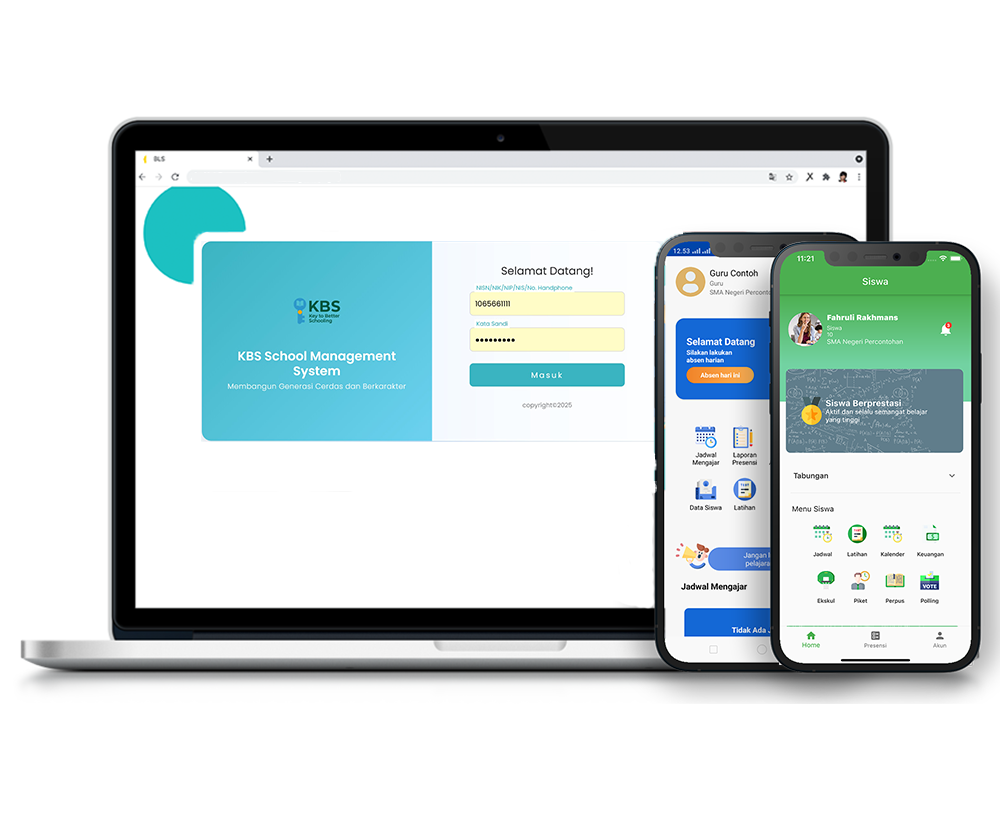
As a comprehensive School Management System, KBS SMS (Key to Better Schooling – School Management System) helps schools prepare for the online learning policy in a fully integrated way.
1. Centralized academic data management
All student data, grades, and attendance records are stored and managed in one place.
2. Support for online learning
Teachers can manage learning materials, assignments, and student activities entirely through the platform.
3. Digital exam management
From question creation to exam monitoring, the entire assessment process is handled within a single system.
4. Improved operational efficiency
School administration becomes faster, more organized, and easier to manage at every level.
Schools can start preparing for the 2026 online learning policy today with a system like KBS SMS.
The Impact of Implementing an Integrated System
Schools that adopt an integrated school management system can expect to see measurable improvements across all areas:
1. Operational efficiency
Workflows become faster, more structured, and less dependent on manual effort.
2. Data accuracy
All data is validated, up to date, and easily accessible whenever it is needed.
3. Improved learning quality
Better monitoring leads to more responsive teaching and stronger student outcomes.
Long-Term Benefits for Schools
1. Readiness for evolving education policies
Schools are better equipped to adapt quickly as regulations and requirements continue to change.
2. Data-driven decision-making
Leadership can make more accurate, strategic decisions based on reliable, real-time data.
3. Greater competitiveness
Schools that embrace integrated digital management stand out as modern, forward-thinking institutions.
Conclusion
The 2026 online learning policy will bring sweeping changes to Indonesia's education system. Schools that are unprepared will face compounding operational and academic challenges.
Digitalization is not simply about using technology — it is about managing that technology in an integrated, purposeful way.
With the right school management system, schools can run all of their processes through a single efficient, structured, and modern platform.
Solutions like KBS SMS help schools do more than just comply with policy — they help schools elevate the overall quality of their education management for the long term.