Admin KBS
Author
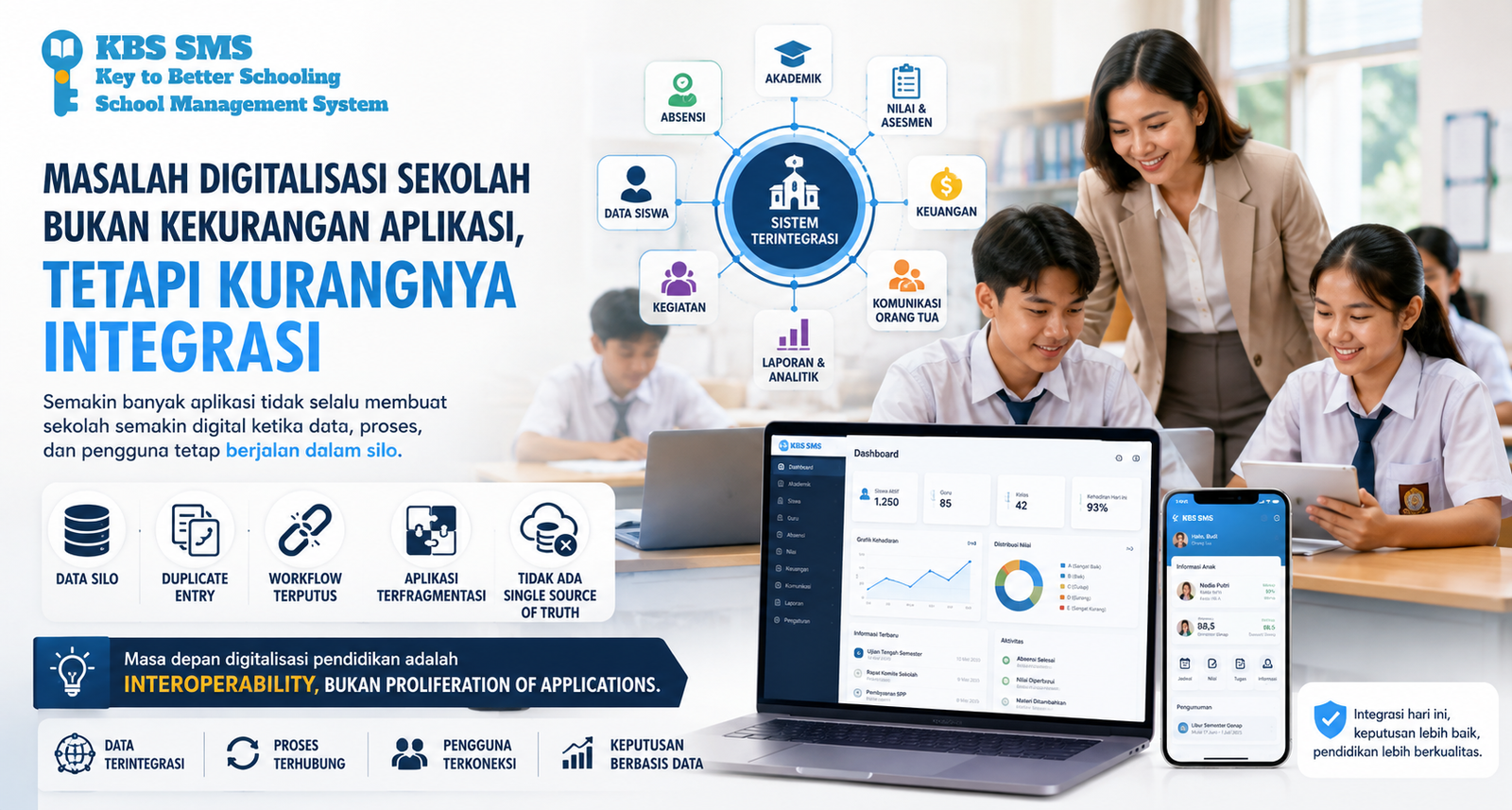
More applications do not inherently make a school more digital when data, processes, and users remain trapped in silos.
Indonesian education digitalization is growing rapidly. Schools now utilize technology for learning, attendance, assessments, report cards, finance, new student admissions, teacher administration, parental communication, and government reporting. However, a higher quantity of apps does not necessarily equate to a mature digital school environment.
Even at the national level, the Ministry of Primary and Secondary Education (Kemendikdasmen) revealed in January 2025 that there were over 986 unintegrated education applications. This fragmentation created data silos and management inefficiencies, which became a primary driver for developing Rumah Pendidikan as an integrated digital service portal. This issue highlights a core paradox in digital transformation: the problem with digital education isn't always a lack of apps; in many cases, issues stem from having too many isolated systems that cannot communicate with one another (Kemendikdasmen).
This exact challenge plays out at the school level. A school might maintain separate systems for academics, attendance, learning management (LMS), examinations, payments, library management, administrative spreadsheets, parent communication, and government reporting. Individually, each system may function as intended. However, if student data must be re-entered multiple times, teachers must juggle separate apps, information fails to synchronize, and principals still have to merge spreadsheets manually to see the full picture, true digital transformation hasn't been achieved yet. The school simply possesses numerous digital touchpoints rather than a unified digital ecosystem.
986 Applications: When Fragmentation Becomes a National Issue
Fragmentation is not merely a theoretical issue; Kemendikdasmen explicitly identified it as a primary challenge in Indonesia's educational digital transformation. When Rumah Pendidikan was launched in January 2025, the ministry stated that digital transformation faced fragmentation due to over 986 unintegrated applications, leading to data silos and operational inefficiencies.
Consequently, government policy shifted from adding as many applications as possible toward consolidating digital services. Kemendikdasmen explained that services from those 986+ apps were simplified into eight integrated spaces within Rumah Pendidikan. The roadmap outlines clear future phases:
- 2025: Service integration
- 2026–2027: Ecosystem strengthening via APIs and data interoperability
- Beyond: Development of a mature digital ecosystem
By January 2026, Kemendikdasmen reported that over 950 applications had been integrated into the eight spaces of Rumah Pendidikan, serving roughly 51 million students and 4 million teachers across primary and secondary education levels. (Vokasi Kemendikdasmen, Kemendikdasmen).
This represents a crucial paradigm shift moving from:
building applications → integrating services → building data interoperability
More Applications ≠ Digital Transformation
Consider a school using eight distinct systems:
- App 1: Stores student demographic data
- App 2: Tracks daily attendance
- App 3: Manages core learning content
- App 4: Administers examinations
- App 5: Processes grades and marks
- App 6: Handles tuition and finances
- App 7: Operates the library
- App 8: Communicates with parents
On paper, the school appears highly digitized. However, the core question is: Do all eight systems recognize the exact same student as a unified data entity?
If not, the school suffers from application fragmentation. Each application maintains its own database, user accounts, workflows, data structures, and reporting tools. The school has achieved digitization of individual activities, but lacks overall process integration. Mature digitalization isn't just giving every activity its own app—it should make previously disconnected activities more connected, streamlined, and manageable.
Problem 1: Duplicate Data Entry
The most recognizable symptom of a fragmented system is duplicate data entry. Student identity data is often required across academic, attendance, exam, payment, library, extracurricular, counseling, admissions, and parent-communication portals. Without system integration, identical data must be keyed in repeatedly.
This wastes time and introduces severe data inconsistency:
- System A records a student in Class 10-A, while System B still reflects Grade 9.
- Parent contact details update in one app but remain outdated in another.
- A transferred student remains listed as active on specific systems.
It leaves the administration asking a fundamental question: Which data is the single source of truth?
International research confirms this is non-trivial. A World Bank study on educational information systems noted that portals developed independently using varying technologies lead to poor interoperability and force duplicate data collection, input, and storage, ultimately limiting efficiency, accuracy, security, scalability, and data usability for decision-making. (World Bank)
Problem 2: Data Silos
Duplicate data entry inevitably results in data silos—where information remains trapped within one system and is difficult for other units to access.
In a typical school environment:
- Attendance data lives in the attendance app.
- Academic grades sit in the academic portal.
- Exam results remain in the assessment platform.
- Financial balances stay in the finance software.
- Behavioral and counseling records are isolated elsewhere.
The school holds vast amounts of data, but lacks integrated information. UNESCO highlights that in educational data ecosystems, the core issue is rarely a lack of data; rather, a lack of systematization and fragmented data spaces hinder the ecosystem, making harmonization, data sharing, and integration critical to breaking down silos. (UNESCO)
Meaning:
More data does not automatically mean better information.
Data yields value only when it can be contextualized, connected, and used for actionable decision-making.
Problem 3: Fragmented Workflows
Fragmentation severely affects daily operations. Consider a teacher's typical routine:
- Log into App A to record morning attendance.
- Log into App B to upload teaching materials or assign homework.
- Use App C to administer a quiz.
- Input grades into App D.
- Manually copy specific summaries into a spreadsheet.
- Re-enter final reports into administrative platforms.
While the teacher uses digital tools for every step, the overall process remains disjointed:
Login ➔ Input ➔ Logout ➔ Login to another app ➔ Search for same data ➔ Re-input ➔ Export ➔ Copy ➔ Re-upload
This produces a clear paradox: the process is digital, but the workflow isn't simpler.
Research by Maharani & Meynawati (2024) indicates that while digitalization can accelerate student data management and reporting, improper implementation strategies introduce negative friction. Process design determines whether technology reduces workload or merely shifts it onto a screen.
Problem 4: Loss of a Single Source of Truth
Fragmentation poses the greatest threat to leadership decision-making. Suppose a principal wants to identify:
Which students over the last three months have shown declining grades, increased absenteeism, recorded behavioral notes, and require intervention?
The data exists, but it is scattered across multiple isolated platforms. To answer this single question, staff must download separate attendance records, pull grade books, open counseling logs, merge spreadsheets, clean mismatched data, and cross-reference student IDs.
The issue isn't a lack of data—it's a lack of connected data. A single source of truth ensures that core identities (students, teachers, classes, subjects) remain uniform across all school operations.
From Application-Centric to Data-Centric Digitalization
In the early stages of digital adoption, schools ask: "Which app do we need?" As digital maturity increases, that question must shift to: "Which data and processes do we need to connect?"
This change brings the school from application-centric digitalization to data-centric digitalization.
To put it simply, it could be visualized as below:
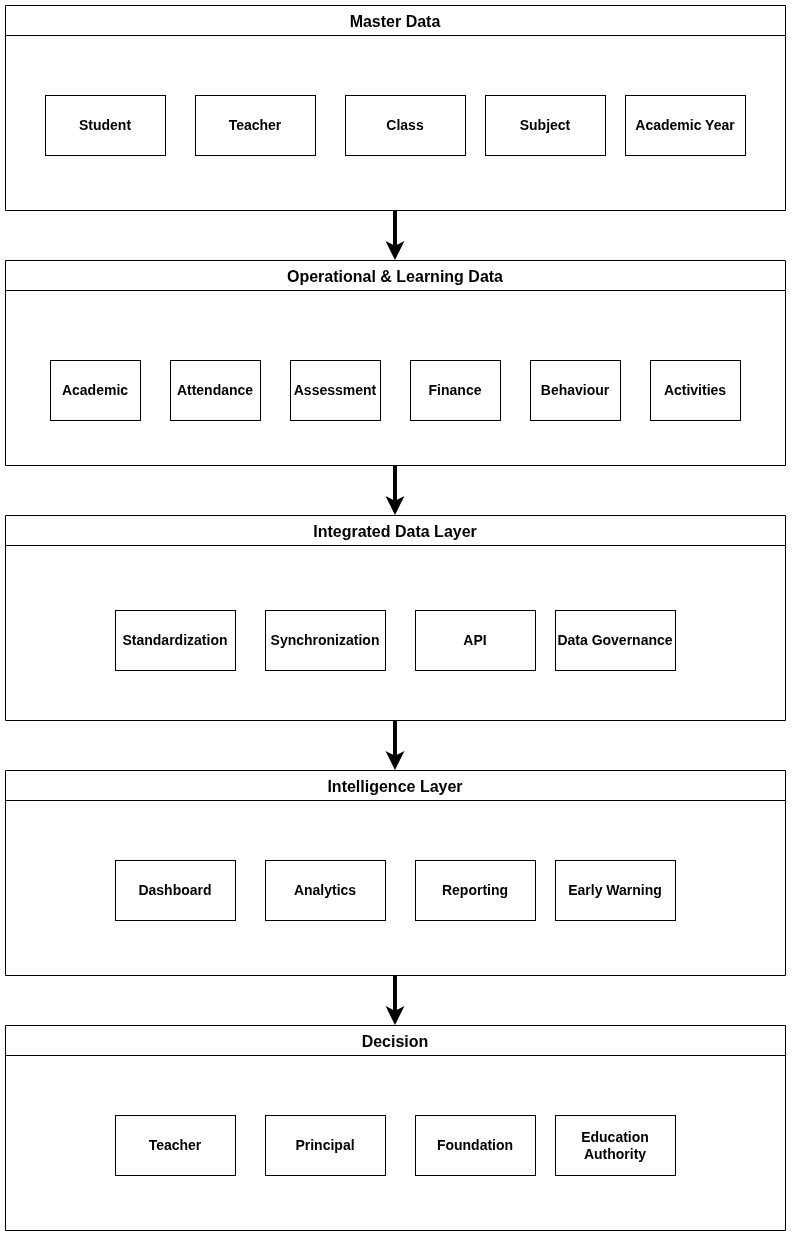
In a data-centric model, applications are no longer the focal point of transformation data and unified processes are.
Interoperability: The Core Strategy
Integration does not mean a school must rely on one single monolithic application. Schools are complex institutions that may still require specialized tools: dedicated LMS solutions, external payment gateways, library platforms, government systems, third-party learning apps, or AI services.
Therefore, the ultimate objective is not one application for everything, but rather different systems that seamlessly work together. This is interoperability.
UNESCO identifies interconnected and interoperable data systems as a foundational pillar for educational digital transformation. Modern Education Management Information Systems (EMIS) are evolving toward interoperable architectures to ensure data flows effectively from central government levels down to local authorities and individual schools. Interoperability is not just a technical detail for developers—it is a core educational transformation strategy.
APIs: The Bridge Between Systems
An Application Programming Interface (API) allows distinct software systems to exchange structured data automatically.
Master Data Updated ➔ Academic System Updated ➔ Attendance System Synced ➔ Exam Platform Syncs Student ID ➔ Finance System Matches Record
This architecture enables schools to follow a clear operational rule: Enter once, use many times instead of Enter many times into many applications.
This aligns with Indonesia's national digital roadmap. Following initial app consolidation in 2025, Kemendikdasmen positioned APIs and data interoperability at the core of its 2026–2027 ecosystem strengthening phase. (Vokasi Kemendikdasmen)
This means that interoperability is not a technological concept that is far from the Indonesian context. It has become part of the direction of digital transformation of national education.
Integration Requires Data Governance
Connecting software via APIs without proper management can propagate flawed data faster. Interoperability must be paired with clear data governance:
- Who owns each data point?
- Which system functions as the primary master database?
- Who has read/write permissions?
- How is data validated and synchronized?
- What are the data retention policies?
- How is student privacy protected and access audited?
UNESCO developed tools like EMIS-PATT to evaluate not just technology, but also data governance, interoperability, data quality, and evidence-based decision-making. (UNESCO) Integration without governance yields connected chaos.
Key Data & Facts
The following figures illustrate why system integration has become a strategic priority:
- >986 Education Apps: Identified by Kemendikdasmen as previously unintegrated, creating data silos and inefficiencies. (Kemendikdasmen)
- 8 Integrated Spaces: Rumah Pendidikan consolidated these services into eight primary functional hubs. (Kemendikdasmen)
- >950 Apps Integrated: Integrated into Rumah Pendidikan as of January 2026. (Kemendikdasmen)
- ~51M Students & 4M Teachers: The approximate scale of the primary and secondary education ecosystem served. (Kemendikdasmen)
- 2026–2027: API & interoperability: Explicitly focuses on API adoption and data interoperability. (Vokasi Kemendikdasmen)
- >60% Potential Cost Efficiency: Estimated savings in technology development costs projected by the government through centralized development consolidation. (Vokasi Kemendikdasmen)
The data provides a consistent message:
The more mature the digital transformation, the more important integration is than just adding applications.
The Role of School Management Systems
At the school level, integration principles are applied using a comprehensive School Management System (SMS). An SMS should not be viewed merely as a collection of feature modules; its primary value lies in connecting data, users, and school workflows.
The documentation for KBS SMS illustrates how core school operations interconnect across a central system:
School Data ➔ Learning ➔ Academics ➔ Attendance ➔ Exams ➔ Admissions ➔ Library ➔ HR ➔ Master Registry ➔ School Finances
The goal of an SMS is not to force every tool into a single app, but to ensure diverse processes rely on consistent data and operate within one unified ecosystem.
Integrated School Platform Should Not Become a Closed Ecosystem
But there’s one important principle during the development for a platform like KBS SMS.
Integrated does not mean it is isolated
Platforms that integrate many internal functions but could not communicate with the other systems will end up creating new silos on a wider scale.
WIth that, School Management System (SMS) ideally shifts from:
multi-module platform
↓
integrated school platform
↓
API-enabled platform
↓
interoperable education ecosystem
Within this context: API capabilities, data standardization, Single Sign-On, role-based access, audit trail, data portability, and synchronization will be important
It will allow SMS like KBS SMS to function as an open digital backbone for school management capable of interacting with the broader tech ecosystem.
From Integrated Data to a Data-Driven School
Connecting data allows school leadership to leverage actionable insights across functions.
A school principal will have a dashboard with the ability to track:
attendance trend + academic performance + assessment + financial information + student activities.
Or a homeroom teacher receives the indicators that a student:
- decrease on the subject’s attendance,
- dropping grades,
- and changes in activity patterns.
These informations allow the school to:
record → understand → intervene.
UNESCO defines an EMIS as a coordinated system of people, technology, and processes designed to deliver quality data for educational decisions (IIEP). Data integration serves as the bedrock for a data-driven school.
Preparing for an AI-Ready School
Artificial Intelligence requires structured, consistent, contextualized, and responsibly managed data. Implementing AI in a school with ten separate systems containing conflicting IDs, duplicate records, and inconsistent formats is extremely difficult.
Integrated data lays the ground for advanced capabilities:
- Learning analytics
- Automated early warning indicators
- Personalized learning recommendations
- Attendance anomaly detection
- AI-assisted administrative support
Digital transformation toward AI does not begin with a chatbot—it begins with a healthy data architecture.
6 Steps for Schools to Achieve Integration
Schools do not need to replace all existing systems immediately. Transformation can begin with six practical steps:
-
Audit All Applications:
Catalog every app, spreadsheet, database, and platform in use. Focus on identifying what data lives inside each tool.
-
Map Duplicate Entries:
Identify data points entered multiple times across systems (e.g., student IDs) to find primary integration targets.
-
Establish Master Data:
Designate a single definitive source for core entities: students, teachers, classes, subjects, and academic years.
-
Map Workflows:
Trace complete operational paths (e.g., Admissions ➔ Registration ➔ Class Placement ➔ Schedule ➔ Attendance ➔ Assessments ➔ Report Cards) to pinpoint broken data links.
-
Set Interoperability as a Procurement Requirement:
When acquiring new software, evaluate API availability, export options, data structure documentation, and security standards alongside feature sets.
-
Implement Integration in Phases:
Prioritize high-frequency workflows first:
Student Master Data ➔ Academics ➔ Attendance ➔ Assessments ➔ Finance
Evolving Key Performance Indicators for School Digitalization
Digital progress should move beyond surface metrics (e.g., number of computers or apps owned) toward evaluating digital maturity:
- How many computers are available?
- How many apps?
- Is an LMS present?
- Is the attendance digital?
Those indicators will do, but it’s not enough. New metrics should be added for a digital maturity:
- How many times must the same data be entered?
- How many systems share the exact same master data?
- How many workflows are end-to-end digital?
- How fast can leadership access cross-functional reports?
- Can cross-functional data be analyzed together?
- Can the system exchange data through clear standards?
With this, schools can start to measure for digital maturity, not merely adopting the technology.
Conclusion: The Future is Interoperability, Not Application Proliferation
Indonesia's consolidation of over 986 education applications demonstrates that app proliferation without integration creates systemic friction. (Kemendikdasmen)
At the school level, more apps do not automatically make a school more digital.
When the system is not inter-connected:
App Proliferation ➔ Data Fragmentation ➔ Increased Duplicate Entry ➔ Administrative Fatigue ➔ Isolated Data Silos ➔ Impaired Decision-Making
Schools must shift their operational paradigms:
- Application-Centric ➔ Ecosystem-Centric
- Data Silos ➔ Integrated Data
- Duplicate Entry ➔ Enter Once, Use Many Times
- Isolated Tools ➔ Interoperable Platforms
- Digital Administration ➔ Data-Driven & AI-Ready School
UNESCO itself places interconnected and interoperable data systems as an important part of educational digital transformation. Meanwhile, Indonesia's policy direction for 2026–2027 has also included APIs and data interoperability as part of strengthening the education digital ecosystem. (UNESCO) (Vokasi Kemendikdasmen)
An integrated platform like KBS SMS serves as an ecosystem backbone connecting academic management, student tracking, learning processes, and administrative workflows into a cohesive whole.
The central strategic question for school leadership is no longer "How many apps do we have?" but rather: "How effectively do our systems, data, teachers, students, and processes operate as a single, interoperable ecosystem?"
Because the future of digitalized education is not about who has more applications. The future of digitalized education is about interoperability.