Admin KBS
Author
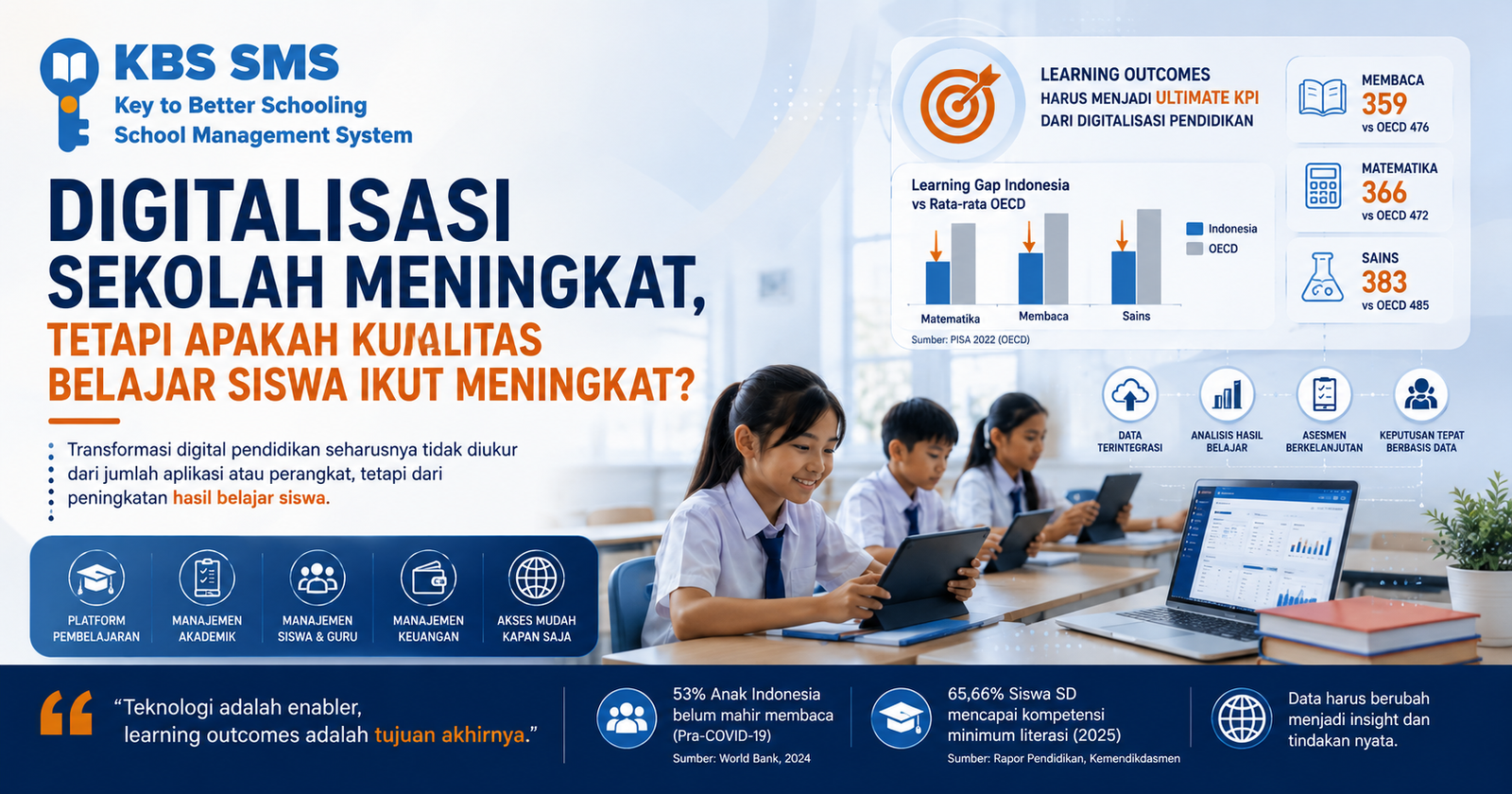
The digital transformation of education should not be measured by the number of applications or devices, but by the improvement in student learning outcomes.
Educational digitalization in Indonesia continues to develop. Learning platforms, digital assessments, school information systems, learning devices, communication applications, and even the use of artificial intelligence are beginning to become part of the educational ecosystem.
These changes bring significant opportunities. Technology can expand access to learning resources, increase administrative efficiency, assist teachers in conducting assessments, strengthen school communication, and provide educational data that was previously difficult to collect and analyze systematically.
However, amidst the increasing use of technology, there is a far more fundamental question:
Does the increasing digitalization of schools truly make students learn better?
This question is important because digital transformation is not the ultimate goal of education.
The ultimate goal remains student development: the ability to read and understand information, numeracy, science, critical thinking, problem-solving, and using knowledge and skills in real-life situations.
Therefore, the success of educational digitalization should not stop at technology adoption. A more substantive measure is learning outcomes.
Indonesia's Learning Outcomes Still Face Challenges
Data from the Programme for International Student Assessment or PISA 2022—the latest PISA results published as of August 2026—shows that Indonesian students' abilities still face major challenges.
Indonesia's average scores are recorded as:
-
Mathematics: 366, compared to the OECD average of 472;
-
Reading: 359, compared to the OECD average of 476; and
-
Science: 383, compared to the OECD average of 485.
Thus, there is a gap of around 100 points between Indonesia's achievement and the OECD average in all three domains. This data serves as one important indicator that improving the quality of learning must remain a primary agenda for Indonesian education.
Domestic indicators show some development after the pandemic period, but challenges remain unresolved. Analysis based on the Education Report Card (Rapor Pendidikan) used in KBS SMS's strategic studies noted that at the elementary school (SD) level in 2025, approximately 65.66% of students achieved the minimum literacy competency.
The World Bank also provides a perspective through the learning poverty indicator. In the Indonesia Learning Poverty Brief edition of April 2024, the World Bank estimated that 53% of Indonesian children at the end of primary school age are not proficient in reading, after accounting for children out of school. It is important to note that this estimate uses learning data available before school closures due to the COVID-19 pandemic, so it should not be interpreted as the 2024 or 2026 condition.
These data points lead to one important conclusion:
Indonesia not only faces the challenge of expanding educational digitalization but also must ensure that this digitalization truly contributes to improving the quality of student learning.
A Digital School Is Not Necessarily a School with Quality Learning
The success of digitalization is relatively easy to showcase through tangible indicators.
How many devices are available?
How many applications are being used?
How many teachers are using digital platforms?
How many administrative processes have moved from paper to electronic systems?
How many exams are conducted online?
These indicators remain important for measuring readiness and the level of technology adoption. However, technology adoption is not an educational outcome.
A school can use many applications without experiencing meaningful changes in learning quality. Conversely, relatively simple technology, when used based on clear learning needs, can generate greater educational value.
UNESCO's study through the Global Education Monitoring Report 2023: Technology in Education also reminds us that the impact of educational technology depends heavily on the context of its implementation. Technology can provide benefits to learning, but the results are influenced by various factors, including access, governance, teacher readiness, content quality, and pedagogical approaches.
In other words:
More technology does not automatically mean better education.
Start with the Educational Problem, Not the Technology
One of the necessary paradigm shifts is how schools begin their digital transformation journey.
The first question should not be:
"What technology or application do we need to use?"
But rather:
"What educational problem do we want to solve?"
Manos Antoninis, Director of the UNESCO Global Education Monitoring Report, emphasized the importance of this approach in discussions regarding the development of educational technology in Southeast Asia: educational needs should be the starting point, not technology itself.
This principle has significant implications.
If the problem is students struggling with numeracy, technology should help teachers understand which competencies have not been mastered.
If the problem is high absenteeism, technology should help schools find patterns and students who need attention.
If the problem is ineffective remedial programs, technology should help teachers know whether interventions are producing improvement.
Technology is thus positioned as an enabler for solving educational problems, not as the goal of transformation itself.
From Technology Adoption Towards Learning Outcomes
The way we measure the success of educational digitalization needs to evolve.
It is no longer enough to ask:
"How digital is our school?"
The next question must be:
"What has changed in student learning processes and outcomes after the school became more digital?"
Simply put, the transformation chain can be depicted as:
Technology → Better Teaching & Learning → Better Diagnosis → Better Intervention → Improved Learning Outcomes
Technology is at the beginning of the chain.
Learning outcomes are at the end.
The simplest example is digital assessment.
When paper-based exams are moved to computers, schools gain efficiency. Grading becomes faster, administrative processes are reduced, and data becomes easier to store.
But that is only the digitalization of the process.
A more substantive transformation occurs when assessment results can help schools answer questions like:
What competencies have students not mastered?
Which material causes the most difficulty?
Which students show a decline in achievement?
Does the difficulty occur individually or in most of the class?
Does the remedial program result in improvement?
What intervention should be taken next?
This is where technology moves from merely being a digital assessment tool towards providing assessment intelligence.
Having Lots of Data Does Not Necessarily Lead to Better Decisions
Modern schools generate increasing amounts of data every day.
Student data, attendance, grades, assignments, exams, remedial, learning achievements, class activities, extracurricular activities, and various administrative information are available in digital format.
But there is a significant difference between:
Data → Information → Insight → Intervention → Improvement
A school can have thousands or even millions of data points but still not be a truly data-driven organization.
The issue is no longer just:
"Do we have the data?"
But rather:
"Does the data help us make better educational decisions?"
Indonesia actually already has a large educational data asset through the National Assessment (Asesmen Nasional), Dapodik, the Education Report Card (Rapor Pendidikan), and various other systems. The next challenge is how this data can be increasingly used to support decisions at the school level.
For example, the following three pieces of information should not always be read separately:
Declining math scores + decreasing attendance rate + assignments increasingly not being completed.
If analyzed in an integrated manner, this combination can be a signal that a student needs attention.
This is where learning analytics and, at a more mature stage, student early warning systems become relevant.
From Report Cards Towards Learning Analytics
Schools are traditionally very strong at producing reports.
However, reports usually answer one question:
What has already happened?
The next stage of data transformation needs to help schools answer deeper questions:
Why did that happen?
Who needs attention?
What should be done?
Conceptually, data usage can evolve through four levels:
Descriptive Analytics → Diagnostic Analytics → Predictive Analytics → Prescriptive Analytics
At the descriptive stage, the school knows that student grades are declining.
At the diagnostic stage, the school tries to understand factors related to that decline.
At the predictive stage, analytics can help identify patterns that indicate risk.
At the prescriptive stage, the system can support educators with information or recommendations to consider relevant interventions.
However, as analytics become more advanced, it is increasingly important to uphold one principle:
technology supports the professional decisions of educators—it does not replace them.
Teachers Remain the Center of Learning Transformation
Technology can find patterns.
Dashboards can show trends.
Algorithms can help provide recommendations.
But teachers understand the student's context.
Studies on educational transformation show that the success of digitalization is not just a matter of technology and curriculum. Teachers remain the agents of change who play a role in integrating technology, developing 21st-century skills, and creating relevant learning processes.
Imagine a system finds that a student's grades have been declining for three months.
Data can show what is happening.
But the teacher still needs to understand:
Is the student having difficulty understanding concepts?
Is the student frequently absent?
Is the learning strategy less appropriate?
Does the student need remedial?
Are there social, family, or psychological factors that need attention through appropriate school mechanisms?
Technology provides visibility.
Data provides evidence.
Teachers provide context, professional judgment, empathy, and intervention.
Therefore, mature digital transformation is not:
Technology replaces teachers.
But rather:
Technology strengthens teachers.
Learning Outcomes Must Be the Ultimate KPI of Educational Digitalization
If students are the center of education, then the success indicators of digital transformation must move closer to student development.
Schools certainly still need operational indicators such as number of active users, teacher adoption rate, module usage, number of digital assessments, or system stability.
However, these indicators are more appropriately placed as enabling or leading indicators, not as the ultimate goal.
More important strategic questions are:
-
Are students' literacy and numeracy skills improving?
-
Is competency mastery increasing?
-
Is the learning gap between students narrowing?
-
Are struggling students being identified more quickly?
-
Is remedial support becoming more targeted?
-
Do teachers have better information for determining interventions?
-
Can student progress be monitored more systematically?
-
Is the achievement gap between classes or student groups decreasing?
With this paradigm, technology is not assessed based on how much it is used, but based on the educational value it produces.
Where Does the School Management System Fit In?
The School Management System holds a strategic position because many school activities generate data that can be used to support educational management.
However, the School Management System should not be positioned as a single solution to low learning outcomes.
Learning outcomes are the product of a complex ecosystem: teacher competency, pedagogy, curriculum, school leadership, family conditions, socio-economic status, learning environment, student characteristics, infrastructure, and various other factors.
Technology is an enabler, not the sole determinant.
In the context of KBS SMS, the relevant academic foundation is already available. KBS SMS documentation includes, among others, exam question banks, class exams, remedial exams, AKM mode exams, exam result reports, item analysis, student grade reports, exam monitoring, Learning Objective Flow (ATP), and Learning Outcome (CP) elements.
This means the next strategic opportunity is not merely adding features.
The opportunity is how the data generated through these various processes can be increasingly translated into insights that help schools understand student development.
Conceptually, the evolution is:
Assessment → Diagnosis → Intervention → Monitoring
not stopping at:
Assessment → Score → Report Card
KBS SMS's strategic analysis identifies the development of a Learning Analytics Engine as one of the future opportunities, including analysis of competency mastery, weak topic detection, and student intervention recommendations. These capabilities represent potential development directions, not a claim of features currently available.
This distinction is important so that product transformation continues based on educational needs while maintaining the credibility of technology communication.
From Digital School to Data-Driven School
School digitalization can be viewed as a gradual journey.
Stage 1 --- Digitization
Documents and manual activities are converted into digital format.
Paper report cards become electronic report cards. Manual attendance becomes digital attendance. Student archives become databases.
Stage 2 --- Digitalization
Various school processes begin to be executed through digital systems.
Teachers enter grades through the system, exams are conducted digitally, and school administration begins to integrate with applications.
Stage 3 --- Integration
Academic data, attendance, assessments, students, teachers, and various school activities become increasingly connected.
Data is no longer confined to separate functions.
Stage 4 --- Data-Driven School
Data is used systematically to support the decision-making of school principals and teachers.
Stage 5 --- Learning Intelligence
Analytics help schools find patterns, understand student development, identify risks earlier, and support intervention planning.
This journey does not have to be completed all at once.
However, the direction of the transformation must be clear.
The 2026 education and digitalization analysis serving as the editorial basis for KBS SMS also concludes that Indonesia is still in a transition from digitalization towards digital transformation: transformation occurs when technology begins to change processes and decision-making, not merely changing the medium.
Questions Every School Should Be Asking
When a school considers new devices, new applications, artificial intelligence, or other technology investments, the discussion should not stop at a list of features.
There are several more important questions:
What educational problem are we trying to solve?
How will the technology improve the learning process or school management?
How does the technology help teachers?
What data will be generated?
Who will use this data?
What decisions can be made better after the technology is implemented?
How will the school measure its impact?
And finally:
How do we know that this technology is genuinely helping students learn better?
This final question should be the focal point of evaluating educational digital transformation.
Successful Technology is Technology That Helps Students Learn Better
Educational digitalization in Indonesia needs to continue moving forward.
However, the next phase requires a higher standard of success.
Success is not adequately demonstrated by an increasing number of devices, applications, dashboards, or digital forms.
A more meaningful transformation occurs when technology helps teachers teach more effectively, school principals make more accurate decisions, parents obtain more meaningful information about their child's development, struggling students are identified earlier, and learning interventions can be carried out more precisely.
Ultimately, all investment in educational technology needs to return to one simple question:
Are students learning better because of the technology we are using?
If the answer is not yet measurable, then the work of digital transformation is not finished.
The future of education is not merely about building increasingly digital schools, but about building schools that are increasingly capable of using technology, data, and human capacity to improve the development of every student.
Therefore, learning outcomes must be the ultimate KPI of educational digitalization.
References
-
OECD. PISA 2022 Results and Indonesia Country Profile / Education GPS. PISA 2022 data shows Indonesia's scores as 366 in mathematics, 359 in reading, and 383 in science.
OECD PISA -
Ministry of Primary and Secondary Education of the Republic of Indonesia. Indonesia's Education Report Card (Rapor Pendidikan Indonesia) and Education Report Card Data 2025. The Education Report Card is used as a source for understanding the achievements and quality of Indonesia's education services.
Rapor Pendidikan Indonesia -- Kemendikdasmen -
World Bank. Indonesia Learning Poverty Brief, April 2024. The brief reports an estimated learning poverty rate for Indonesia of 53% based on pre-COVID-19 learning data available.
Indonesia Learning Poverty Brief -- World Bank -
UNESCO. Global Education Monitoring Report 2023: Technology in Education --- A Tool on Whose Terms? The report discusses opportunities, limitations, evidence of effectiveness, equity, and governance of technology in education.
UNESCO Global Education Monitoring Report -- Technology in Education -
UNESCO Global Education Monitoring Report. Recommendations: Technology in Education. Emphasizes the importance of placing learner needs and educational outcomes as the basis for decisions on technology use.
UNESCO GEM Report Recommendations -
Picauly, V. E. (2024). Transformasi Pendidikan di Era Digital: Tantangan dan Peluang. [Educational Transformation in the Digital Era: Challenges and Opportunities] Indonesian Research Journal on Education, Vol. 4 No. 3. The study discusses the opportunities of technology alongside challenges such as the digital divide, educator readiness, and the need for improving education quality.
-
Tanjung, R. R., Ritonga, A. A., Abdullah, B. M., Siregar, N. A., & Armilah. (2024). Transformasi Digital dalam Pendidikan: Meningkatkan Kualitas Pembelajaran Melalui Teknologi. [Digital Transformation in Education: Improving Learning Quality Through Technology] Sinar Dunia: Jurnal Riset Sosial Humaniora dan Ilmu Pendidikan, Vol. 3 No. 2, 211--217.
-
Hasnida, S. S., Adrian, R., & Siagian, N. A. (2024). Transformasi Pendidikan di Era Digital. [Educational Transformation in the Digital Era] Jurnal Bintang Pendidikan Indonesia (JUBPI), Vol. 2 No. 1, 110--116. Discusses accessibility, interactive learning, educational analytics, teacher training, and the challenges of digital transformation.
-
Volta, A. S., & Nahdiyah, A. C. F. Transformasi Pendidikan di Era 4.0: Intelektualitas Guru Tercipta, Kualitas Sekolah Terjaga. [Educational Transformation in Era 4.0: Teacher Intellectuality Developed, School Quality Maintained] Jurnal Kepengawasan, Supervisi dan Manajerial. The study positions teachers as agents of change and emphasizes that educational transformation is not solely about technology.
-
PT. Kreasi Bali Sasmita. Manual Book KBS SMS. Documentation of KBS SMS functions covering academic management, curriculum, assessment, AKM, remedial, exam result reports, item analysis, monitoring, student data, attendance, and various school management functions.
-
Analisis 10 Isu Terkini Pendidikan Indonesia & Digitalisasi Pendidikan 2026. [Analysis of 10 Current Issues in Indonesian Education & Educational Digitalization 2026] A strategic study document used as the editorial basis for the article, with learning outcomes positioned as the ultimate outcome issue, and digitalization, data, analytics, and technology as supporting factors for improving education quality.
Copyright Notice
This article is official content owned by PT. Kreasi Bali Sasmita Nusantara (KBS SMS).
It is prohibited to copy, distribute, or republish part or all of the article content without written permission from the copyright holder.