Admin KBS
Author

Introduction
In recent years, digitalization has changed almost every aspect of human life, including the world of education.
School administration processes, learning activities, communication between schools and parents, and the management of academic data increasingly make use of digital technology.
However, when discussing school assessment, there is still debate about the extent to which digitalization needs to be implemented.
Some parties see assessment digitalization as an option that can be adjusted according to the conditions of each school.
Others view digitalization as an unavoidable consequence of modern educational transformation.
The question is:
• Is the digitalization of school assessment still merely an option, or has it become a necessity in modern education?
Educational Digitalization Is a Reality, Not a Temporary Trend
In recent decades, the world of education has undergone very significant changes.
These changes are influenced by:
• the development of information technology;
• increasing internet access;
• the need for more complex data management;
• the demands of 21st-century competencies;
• changes in students’ characteristics.
UNESCO and OECD have consistently shown that technology has become an important part of the transformation of global education systems.
Schools today are not only required to teach digital literacy to students, but also to integrate technology into the management and evaluation of learning.
In this context, assessment digitalization is no longer merely an additional innovation, but part of the needs of a modern education system.
Why Is Assessment the Area That Needs Digitalization the Most?
Among the various academic processes in schools, assessment is one of the areas that generates a very large amount of data.
Every year, schools must manage:
• thousands of question items;
• hundreds to thousands of answer sheets;
• student grade data;
• learning outcome analysis;
• remedial programs;
• academic reports;
• reporting to parents and other stakeholders.
When all of these processes are done manually, schools face various challenges such as:
• heavy administrative work;
• risk of calculation errors;
• reporting delays;
• limited data analysis;
• difficulty monitoring student development.
Digitalization helps schools overcome these challenges more effectively and efficiently.
Assessment Digitalization Is Not Just Online Examinations
One common misunderstanding is assuming that assessment digitalization simply means moving questions from paper to a computer screen.
In fact, assessment digitalization has a much broader scope.
Assessment digitalization includes:
Digital Question Bank
Structured and sustainable question management.
Digital Examination Implementation
Multiple-choice questions, essays, and hybrid assessment.
Automatic Grade Processing
Reducing teachers’ administrative work.
Learning Outcome Analysis
Identifying students’ strengths and weaknesses.
Academic Dashboard
Presenting learning outcome data in real time.
Documentation and Reporting
Storing the history of students’ development systematically.
Therefore, the main value of digitalization does not lie in the devices used, but in its ability to generate more accurate and meaningful information.
From Document-Based Schools to Data-Driven Schools
One of the biggest changes brought by digitalization is the shift from:
• Document-Based School
to
• Data-Driven School
In document-based schools, data is often stored in the form of:
• answer sheets;
• separate spreadsheets;
• printed documents;
• manual archives.
As a result, information is difficult to analyze quickly.
In contrast, data-driven schools are able to:
• monitor students’ competency achievements;
• identify learning outcome trends;
• detect remedial needs;
• evaluate question quality;
• support data-based decision-making.
This is one of the reasons why assessment digitalization is becoming increasingly important.
Strategic Benefits of School Assessment Digitalization
Operational Efficiency
Reducing the time needed for:
• correction;
• grade recapitulation;
• reporting learning outcomes.
Assessment Objectivity
Reducing the risk of human error in the assessment process.
Transparency
Making it easier to track and audit academic data.
Learning Analytics
Providing insights that were previously difficult to obtain through manual systems.
Decision-Making
Helping principals and teachers make decisions based on valid data.
Will Digitalization Replace the Role of Teachers?
One concern that often arises is that digitalization will reduce the role of teachers.
In reality, the opposite is true.
Technology does not replace teachers.
Technology helps teachers.
With reduced administrative work, teachers can focus more on:
• teaching and learning;
• student mentoring;
• character development;
• providing feedback;
• learning innovation.
The role of teachers remains the most determining factor in educational success.
Digitalization and Assessment Quality Must Go Hand in Hand
Digitalization is not the final goal.
Digitalization is only a tool.
Schools still need to ensure that the assessments used are:
• valid;
• reliable;
• objective;
• fair;
• relevant to the competencies being measured.
Therefore, digitalization must go hand in hand with:
HOTS Assessment
Higher Order Thinking Skills Assessment.
Hybrid Assessment
A combination of multiple-choice questions and essays.
Project-Based Assessment
Project-based assessment.
Portfolio Assessment
Assessment of students’ competency development.
With this approach, digitalization not only improves efficiency but also improves assessment quality.
Challenges in Implementing Assessment Digitalization
Although it has many benefits, digitalization implementation also faces several challenges.
Infrastructure Readiness
Devices and internet connectivity need to be properly prepared.
Teachers’ Digital Competence
Teachers need adequate training.
Changes in Work Culture
Digital transformation requires changes in mindset and work habits.
Data Governance
Schools need to ensure the security and integrity of academic data.
However, these challenges are not reasons to avoid digitalization, but areas that need to be managed gradually and in a planned manner.
Recommendations for Schools
Develop an Assessment Digitalization Roadmap
Start from the most basic needs.
Digitalize Gradually
There is no need to change the entire system at once.
Focus on Academic Benefits
Not only on administrative efficiency.
Improve Teachers’ Competence
Through training and mentoring.
Use a Flexible Platform
Choose a system that is able to support various assessment models.
Towards a Modern School Assessment Ecosystem
In the future, schools need a system that is able to integrate:
• Digital Question Bank;
• Multiple-Choice Examinations;
• Essay Examinations;
• Hybrid Assessment;
• Project Assessment;
• Portfolio Assessment;
• Learning Outcome Analysis;
• Academic Dashboard.
In this context, digitalization is no longer merely an administrative support tool, but a foundation for schools to build a culture of data-based decision-making.
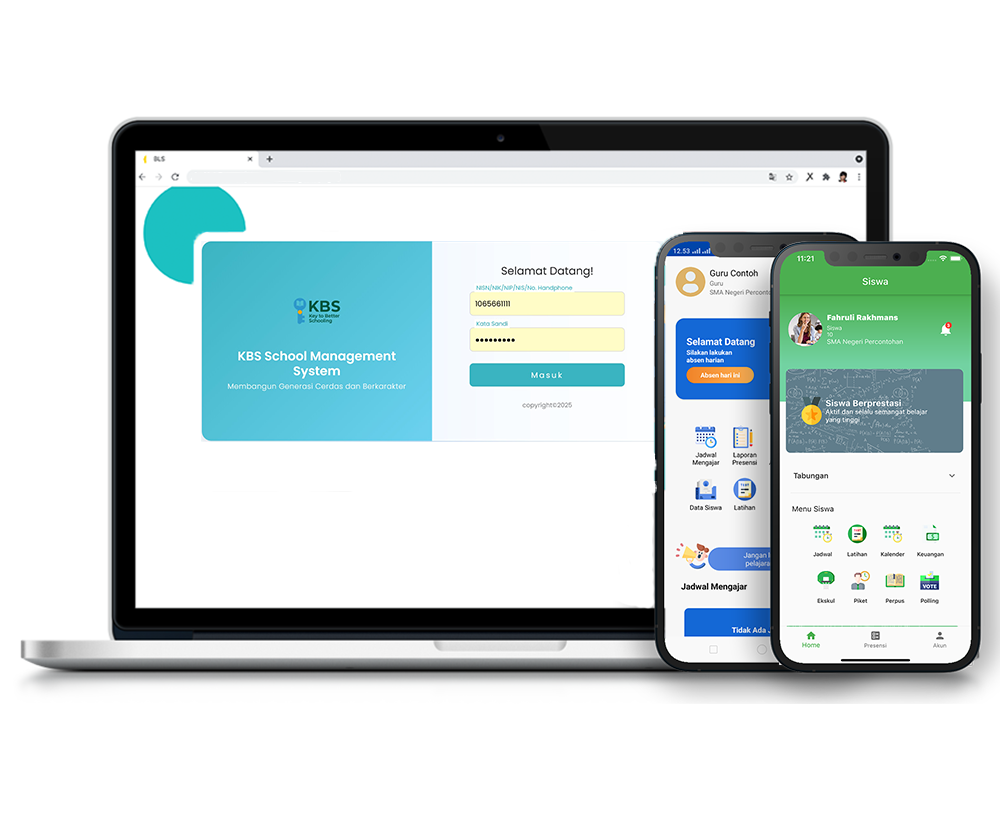
This philosophy is one of the development directions of KBS SMS (Key to Better Schooling – School Management System), namely to support schools in managing assessments in a more modern, integrated, and learning-quality-oriented way.
Conclusion
The digitalization of school assessment is not merely a technological trend.
Digitalization is a need that arises from the complexity of modern education management.
Schools today do not only need systems that can conduct examinations, but also systems that can transform data into information and information into better decisions.
Therefore, the question that needs to be asked is no longer:
• "Do schools need to digitalize assessment?"
But rather:
• "How can schools digitalize assessment effectively to improve the quality of learning?"
The future of education does not lie in the choice between digital or manual.
The future of education lies in schools’ ability to use technology wisely to help students learn, grow, and reach their best potential.
FAQ (Frequently Asked Questions)
What is meant by school assessment digitalization?
Assessment digitalization is the use of technology to manage the assessment process, from question banks, examination implementation, grade processing, learning outcome analysis, to academic reporting.
Does assessment digitalization only mean online examinations?
No. Assessment digitalization covers the entire process of managing assessment and learning outcome data digitally.
Are digital examinations better than manual examinations?
Digitalization is not about completely replacing manual methods, but about improving efficiency, objectivity, and the quality of assessment management.
Will digitalization replace teachers?
No. Technology helps teachers reduce administrative work so they can focus more on learning and student mentoring.
Why do schools need to become data-driven schools?
Because data-based decisions help schools improve learning quality, map students’ competencies, and increase the effectiveness of academic programs.
References
-
UNESCO. (2023). Global Education Monitoring Report 2023: Technology in Education – A Tool on Whose Terms?
-
UNESCO. (2021). Reimagining Our Futures Together: A New Social Contract for Education.
-
OECD. (2023). PISA 2022 Results.
-
OECD. (2021). 21st Century Readers: Developing Literacy Skills in a Digital World.
-
Redecker, C., & Johannessen, Ø. (2013). Changing Assessment: Towards a New Assessment Paradigm Using ICT.
-
Selwyn, N. (2016). Education and Technology: Key Issues and Debates.
-
Luckin, R., et al. (2016). Intelligence Unleashed: An Argument for AI in Education.
-
Black, P., & Wiliam, D. (1998). Assessment and Classroom Learning.
-
Brookhart, S. M. (2010). How to Assess Higher-Order Thinking Skills in Your Classroom.
-
Ministry of Education, Culture, Research, and Technology of the Republic of Indonesia. (2022). Learning and Assessment Guide for the Merdeka Curriculum.
Content Copyright
This article is official content owned by PT. Kreasi Bali Sasmita Nusantara as the developer of KBS SMS (Key to Better Schooling – School Management System).
All contents of this article are protected by copyright. It is prohibited to copy, distribute, or republish part or all of this article without written permission from PT. Kreasi Bali Sasmita Nusantara (KBS SMS) as the copyright owner.